
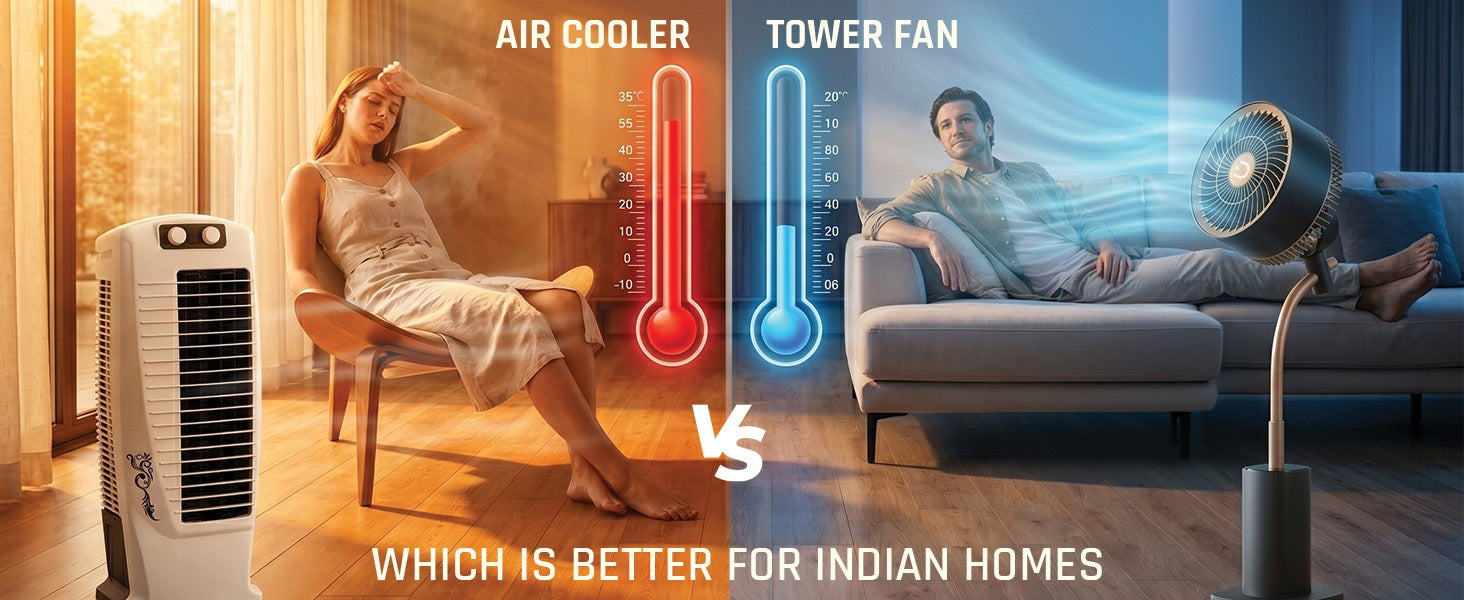
It's the second week of June, your room already feels like an oven by 11 a.m., and you've got around ₹10,000 to fix it. You open a shopping app and hit the same wall every Indian household hits each summer: do you buy a tower fan or an air cooler?
Both promise to keep you cool. Both sit in the same price range. And almost every "best of" list online quietly assumes one answer without telling you why. So before you spend the money, here's the honest version of the tower fan vs air cooler debate what each one actually does, and which one fits the way you live.
They cool in completely different ways
This is the part most buyers skip, and it's the part that decides everything.
An air cooler doesn't really cool air the way an AC does. It pulls warm air through a wet pad, the water evaporates, and the air coming out is a few degrees cooler and a lot more humid. That trick works brilliantly when the air is dry and thirsty for moisture. Think Delhi in May, or Jaipur, Nagpur, and Ahmedabad in peak summer, where the heat is harsh but the air is bone-dry.
A tower fan does something simpler. It doesn't change the room's temperature at all. It moves air across your skin, your sweat evaporates faster, and you feel cooler even though the thermometer hasn't budged. That effect works in any weather, wet or dry.
Hold on to that difference, because it's the whole reason the tower fan vs air cooler answer changes depending on where you live.
The humidity question decides it
India isn't one climate, it's about ten. And an air cooler's biggest weakness is the exact thing half the country deals with: humidity.
If you're in Chennai, Mumbai, Kochi, or Kolkata, you already know that sticky, heavy feeling when the air is full of moisture. Run an evaporative cooler in that air and you're adding even more water to a room that's already saturated. The cooling barely registers, the room starts to feel clammy, and your sheets feel damp by morning. During the monsoon it gets worse.
A tower fan sidesteps all of that. It keeps air moving so sweat can evaporate, which is the one cooling mechanism that still works when humidity is high. That's why, across most coastal and humid Indian cities, a good tower fan quietly beats a cooler for everyday comfort, especially overnight.
So if anyone hands you a blanket "this one is better" verdict in the tower fan vs air cooler argument without asking which city you're in, they're guessing.
Running cost, power, and the bills nobody mentions
Here's where the gap gets wide.
A room air cooler usually pulls somewhere between 100 and 200 watts once you count the fan and the water pump, and bigger desert coolers draw more. A modern BLDC tower fan runs on a fraction of that. The Breezo 3D Air Circulation Tower Fan, for example, sips just 36 watts thanks to its brushless motor, while still pushing serious airflow.
Over a long Indian summer running 10–12 hours a day, that difference shows up on your electricity bill in a way you'll actually feel. A BLDC tower fan is built for exactly this: strong air, small power draw, no compromise. And there's the water. A cooler needs refilling, sometimes twice a day in dry heat. A fan needs a plug. That's it.
Maintenance and hygiene
Air coolers ask for upkeep, and in India that upkeep matters more than the brochure admits. The water tank and cooling pads stay damp, and damp plus warm is how mould, algae, and that musty smell get started. Skip cleaning for a couple of weeks and the "cool" air starts carrying that odour into your room. For anyone with dust sensitivities or young kids, that's worth thinking about.
A tower fan has none of that. No water, no pads, no standing tank. You wipe the grille now and then and you're done. For a home that cares about clean, healthy air, the low-maintenance option is simply easier to live with.
Space, looks, and where it actually fits
Air coolers are bulky. They need floor space, they need to sit near a window for fresh-air intake, and they're not something you want on display in a clean, modern room.
A tower fan is slim by design. It tucks into a corner, takes up roughly the footprint of a floor lamp, and looks like it belongs in a well-put-together home rather than something you hide. If you care about how your room looks as much as how it feels, that matters. It's also why the tower fan has quietly become the default for bedrooms.
Why a tower fan wins in the bedroom
The bedroom is where this comparison gets personal, because the bedroom is about sleep, and sleep gets ruined by two things: noise and clutter.
A cooler hums and gurgles, and the water pump kicks in and out through the night. Choosing a tower fan for bedroom India use solves that. The Breezo, for instance, runs at around 20 dB on its lower speeds, quieter than most conversations and easy to sleep through.
A good tower fan for bedroom India conditions also needs to be considerate in other ways. You want a remote so you're not getting up at 2 a.m. to change the speed. You want a timer or sleep mode so it doesn't run all night for no reason. You want it slim enough to sit beside the bed without being in the way. And in a country where bedrooms double as study corners and work-from-home desks, you want airflow you can point exactly where you need it.
That's the case for a BLDC tower fan in the bedroom: quiet enough for sleep, smart enough to control from bed, and gentle on the power bill even when it runs till morning.
So which should you actually buy?
Strip away the marketing and the tower fan vs air cooler decision comes down to your climate and your room.
Buy an air cooler if you live in a hot, dry region (much of North and Central India), you mostly need to cool a large hall or open space during peak summer, and you don't mind the refilling and cleaning.
Buy a tower fan if you live anywhere humid or coastal, you want something that works all year and not just for two dry months, you care about low running cost, low maintenance, quiet nights, and a clean look, or you're cooling a bedroom or personal space.
For a huge share of urban Indian homes, especially flats in humid cities and any room used for sleeping, that second list is simply the better fit. That's the honest answer to the tower fan vs air cooler question for most people reading this.
The tower fan worth shortlisting
If the tower fan side of the argument sounds like your situation, the Breezo 3D Air Circulation Tower Fan is a strong place to start. It's a BLDC tower fan built around how Indian rooms are really used.
A few things that stand out:
-
3D air circulation: 120° horizontal and 90° vertical oscillation, so air reaches the corners instead of just the spot in front of it.
-
36W BLDC motor: strong airflow (rated at 1290 m³/hour) on very little power.
-
Around 20 dB on lower speeds: quiet enough for a nursery or a light sleeper.
-
12 speed levels plus Normal, Auto and Turbo modes, so you can dial in anything from a barely-there breeze to a strong rush of air.
-
Adjustable height (90–105 cm), touch panel and a magnetic remote, plus a soft mood lamp for the corner of a bedroom.
At ₹9,499 it sits in the same budget as a decent air cooler, but gives you a year-round, low-fuss machine instead of a seasonal one. That's the Domestica idea of made for more in practice: more comfort, less hassle, and a bill you don't dread.
Cooling in India was never one-size-fits-all, and this call shouldn't be either. Match the machine to your weather and your room, and you'll get it right. For most urban homes dealing with heat and humidity, a quiet, efficient fan is the choice that keeps making sense long after summer ends.
Frequently Asked Questions
Is a tower fan or air cooler better for a humid city like Chennai or Mumbai?
In humid, coastal cities, a tower fan is usually the better pick. Air coolers add moisture to the air, which barely helps when humidity is already high and can leave the room feeling clammy. A tower fan keeps air moving so sweat evaporates, which is the cooling that still works in damp weather.
Does a BLDC tower fan really save electricity compared to an air cooler?
Yes, noticeably. A room air cooler typically draws 100–200 watts once the pump and fan are running, while a BLDC tower fan like the Breezo runs at about 36 watts. Over a full summer of daily use, that lower draw adds up to real savings on your bill.
Which is the best tower fan for bedroom India summers?
The best tower fan for bedroom India use is one that's quiet, slim and controllable from bed. Look for a low noise rating (around 20 dB), a remote, a sleep or timer mode, and adjustable height so you can aim airflow at the bed. The Breezo 3D ticks those boxes.
Do air coolers need a lot of maintenance?
More than a fan, yes. The water tank and cooling pads stay damp, so they need regular cleaning to avoid mould, algae and musty smells, and the pads need replacing over time. A tower fan skips all of that no water, no pads, just an occasional wipe-down.
Can a tower fan work during the Indian monsoon?
It can, and this is where it pulls ahead of a cooler. During the monsoon the air is already heavy with moisture, so an evaporative cooler does very little. A tower fan keeps air circulating, which still feels cooling and helps a damp room feel less stuffy.
Is a tower fan a good choice for a small bedroom or a child's room?
It's one of the best choices. A slim tower fan for bedroom India settings fits easily beside a bed or crib, runs quietly enough not to disturb sleep, and uses very little power. Features like a soft mood lamp and a gentle low-speed mode make it well suited to nurseries and kids' rooms.
Stay cool and discover smarter home-care solutions with Domestica. Follow us on our Instagram page for daily cooling tips, product updates, and inspiration, and join our Facebook community for the latest home-care ideas, announcements, and exclusive content.

Leave a comment
This site is protected by hCaptcha and the hCaptcha Privacy Policy and Terms of Service apply.